Every HR leader we speak with now asks the same question about creating an agentic HR function: We understand the general destination, but how do we get there?
We believe their approach should be rooted in what makes the agentic transformation different. In earlier HR transformation waves, the human was always the unit of execution, and technology was a tool that humans operated. Agents change that assumption. They can reason, act across systems, and be orchestrated into teams that are supervised and held accountable. The rise of agents changes the redesign problem in two ways.
First, speed and frontline customization increase sharply. A payroll specialist or a recruiter can now configure a working agent in an afternoon using low-code tools. This is the greatest accelerant of the transformation and, at the same time, its greatest governance challenge. Local experimentation and design, without proper guardrails, can harden into a fragmented landscape of one-off agents faster than any central team can catalog it.
Second, HR must transform itself at the same pace it is asking the enterprise to move. In the ERP and agile eras, HR was largely a downstream adopter of changes designed elsewhere. In the agentic era, HR has a dual mandate as both the architect of the enterprise’s human–agent redesign and a subject of that same redesign. A function that moves slower than the organization it advises, or that automates tasks while preaching workflow redesign, forfeits the credibility to lead.
The implication is uncomfortable for leaders trained on the last two decades of transformation: The instinct to “start small and learn” is no longer conservative. When any specialist can stand up an agent in an afternoon, starting small happens whether leadership sanctions it or not. The question is whether those efforts unfold within a deliberate design or instead of one.
In prior transformations, moving without a blueprint cost time. In this one, it costs the blueprint itself—every ungoverned agent hardens a fragment of the old operating model into code. We call this the pilot trap: speed at the level of the task, drift at the level of the design. That is why the redesign can’t be managed pilot by pilot and why the journey must run from what we call “North Star back.”
A North Star should solve three core tensions
Organizations are approaching the agentic HR journey in different ways. In our work with a wide range of companies, we see several common patterns emerging, from a focus on a small number of use cases ripe for agentification to a full reinvention of HR. Having watched these patterns play out, we believe they are not equal alternatives.
The default should be the North Star–back approach: Define the 2030 human–agent operating model for the function first, then work backward to the implementation sequence, capability investments, governance structures, and quick wins needed to get there. Everything else is an entry point into that journey, not a substitute for it.
In creating the North Star, some elements are commonly understood: AI frees humans for more strategic work, and humans bring judgment while agents propel scale. The harder conversations we have with executives involve three core tensions:
- Who owns the orchestration platform? The agents belong to HR, but the platform they run on is enterprise infrastructure covering identity, security, integration, and orchestration. If IT owns it outright, HR waits in a queue and loses the pace advantage that makes agents valuable. If HR builds its own, the enterprise inherits a shadow stack. The same question repeats inside HR: Which agents are built centrally as products, and which are configured locally by the people who own the workflow?
- Investment versus surveillance: Agentic HR can finally tailor its work to the individual rather than the segment, anticipating a career move, curating the next role, and tailoring development to how someone actually works. The same capability that goes one notch too far or is introduced without transparency stops feeling like an investment and starts feeling like surveillance. The line is not set by regulation. It is set by whether employees believe the personalization serves them.
- Automating work versus accelerating people: The easy decision is what agents should absorb. The harder one is determining which human capabilities become more valuable (judgment, relationships, coaching, persuasion) and where the organization will deliberately accelerate them, in HR and the business alike. That includes cognitive load, or the amount of mental effort employees must expend as they incorporate AI into their work, as well as rebuilding the apprenticeship path. If agents take the entry-level work, the next generation’s judgment has to be developed on purpose rather than absorbed on the job.
None of these tensions is solved once; they are managed continuously. A North Star that does not take an explicit position on all three is not yet a North Star.
This approach must also be rooted in an understanding of how HR meets evolving business needs, not just technological possibilities. That includes defining HR’s role in supporting the enterprise-wide workforce changes that accompany the AI transformation ahead: redesigning workforce models and building human–agent collaboration capabilities that create economic and strategic impact. Based on changing workforce needs, HR can help attract new talent, and redeploy existing talent, to fill future roles. And it can meet employee expectations for a more seamless and compelling employee experience.
Once the North Star is established, organizations pursue two tracks in parallel: a bottom-up track that generates quick wins and builds momentum, and a structural redesign track that progressively transforms the HR function in line with the broader vision. The two tracks reinforce each other. Quick wins help to test the broader vision, while the North Star ensures that individual initiatives fit together as part of a coherent whole rather than a collection of disconnected solutions. Success also depends on close collaboration with IT and other business functions whose work is tightly linked to HR’s transformation. Over time, this approach rebuilds the HR function into a platform that enables the agentic organization of the future while continuing to improve performance.
Three entry points, not three strategies
Where, then, should an organization generate its first proof points? Bottom-up use cases, end-to-end process redesign, and domain-by-domain reinvention are best understood as entry points into the North Star–backed journey. Deciding which to tackle first depends on an organization’s starting point, data maturity, risk appetite, and leadership readiness.
Bottom-up use cases
Some organizations start by identifying pain points across the HR function, agentifying them selectively, and building momentum through quick wins. Technologically mature organizations put technology in the hands of all employees, turning everyone into a “citizen developer.” Fast and tangible, this method generates individual and organizational confidence and early proof points that are invaluable. One organization following this path implemented 50 use cases, each valuable on a small scale, from an AI-powered chatbot for employee queries to automated meeting synthesis to AI-augmented learning and performance management. As a result, the company identified significant annual cost savings along with meaningful improvements in HR service levels.
The danger of this approach is that its impact can be limited if individual use cases aren’t tied to a broader redesign of workflows, roles, and HR capabilities. In some cases, organizations improve the efficiency of processes that, once work is redesigned end to end, are ultimately eliminated or absorbed into entirely different workflows. This is the pilot trap at work: effort spent perfecting steps that the future operating model eliminates. Successful organizations pair local experimentation with top-down architectural standards, governance, and clear technology principles that enable solutions to scale across the enterprise while keeping the agent landscape maintainable and controlling the growing costs of compute and AI infrastructure.
End-to-end process redesign
Other organizations focus on a small number of end-to-end HR processes, reimagining them as human-plus-agent systems and using them as a blueprint for broader change. In practice, the starting point is often a set of administrative processes such as payroll, document management, onboarding administration, or query handling. These workflows typically offer cleaner data, more transparent process steps, and faster time to value, making them well suited to quickly prove the model and build organizational confidence. Once the HR function begins to learn what agentic redesign feels like in practice (what works, what breaks, the data requirements, and the change management needed), it can apply that logic across the entire function. A global auto manufacturer followed this path by redesigning two end-to-end processes in parallel. Based on what it learned, the manufacturer developed a comprehensive vision for a full redesign of its HR function.
Domain-by-domain reinvention
The most ambitious organizations take each HR domain (talent acquisition, learning and development, total rewards, performance management, HR business partnering) and rebuild it from the ground up as an agentic system, with all underlying processes reimagined as human-plus-agent workflows. This is not incremental improvement but a reinvention of how each domain operates, is staffed, and creates value. It requires the highest level of leadership conviction and organizational readiness and produces the most transformative outcomes at speed because it leaves no part of the HR function untouched. In practice, this is the North Star–back journey begun at full scale, the entry point for organizations whose conviction and readiness allow them to skip the on-ramp.
The prescription is straightforward. Every organization needs early proof points, and they can legitimately come from any of these entry points. What cannot vary is the governing logic: Proof points must be selected, sequenced, and judged against a clear view of the future operating model. The journey must be deliberate, sequenced, and governed, rather than emerging organically from a collection of disconnected pilots.
The destination: What HR could look like by 2030
For organizations that have begun their agentic journey, a clearer picture of the future HR function is emerging. McKinsey analysis indicates that, by 2030, roughly two-thirds of today’s HR activities, from requisition management and candidate screening to payroll processing, onboarding, and benefits administration, could be fully automated or fully automated in delivery (Exhibit 1).
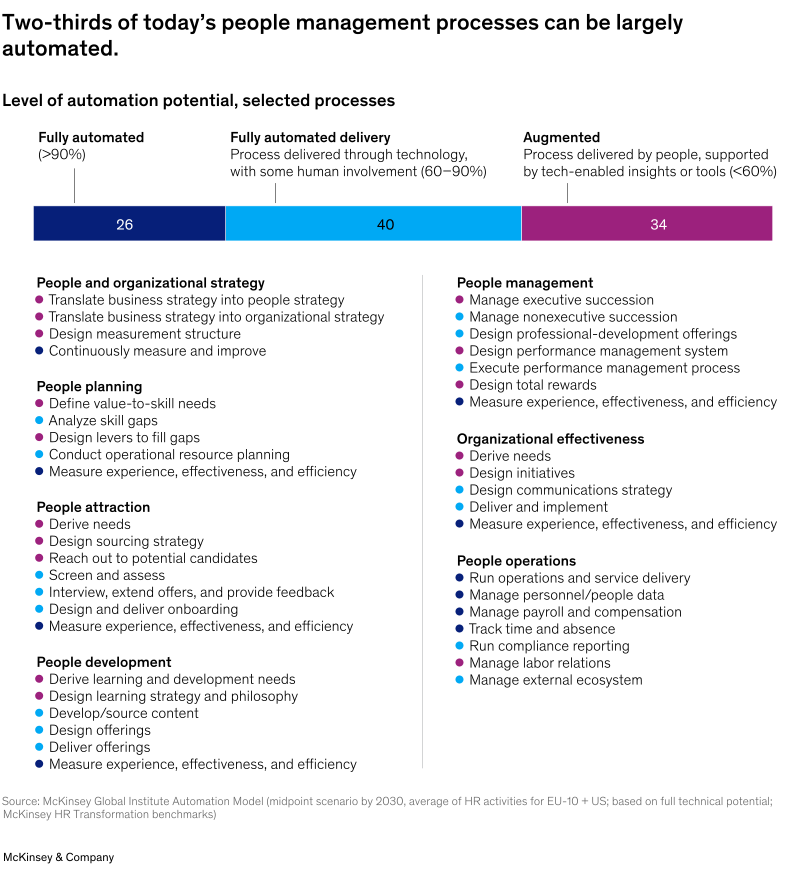
Fully automated means an agent completes the work end to end with no routine human involvement, such as generating an employment verification letter, scheduling an interview loop, or answering a benefits eligibility question.
Fully automated in delivery means agents execute the workflow while humans retain ownership of policy, outcomes, and exceptions. Payroll is the canonical case: Agents run the cycle, and humans design the policy and adjudicate the garnishment, the cross-border complication, and the case that doesn’t fit the rules.
Augmented describes the remaining work, in which humans lead and agents prepare, analyze, and draft. For example, a business partner who walks into a succession review with agent-assembled analytics still owns the judgment in the room.
The distinction matters because the larger share of HR work falls into the second and third categories. That is exactly why a task-automation framing understates the redesign requirement. The question across HR is not whether a human is involved, but where human judgment sits in a workflow that agents largely execute.
The implications for how HR professionals spend their working day are profound. Today, the typical HR function allocates roughly 40 percent of its time to operational delivery, 30 percent to program and project execution, and 15 percent to ad hoc problem solving. That leaves roughly 15 percent for strategic engagement and innovation. In an agentic HR model, that balance is likely to shift dramatically: operational delivery shrinks to approximately 5 percent of human time, program and project execution to roughly 10 percent, and ad hoc problem solving to 15 percent. This allows 50 percent of human time to be dedicated to strategic engagement and innovation, while roughly 20 percent is allotted to agentic capability management (Exhibit 2).
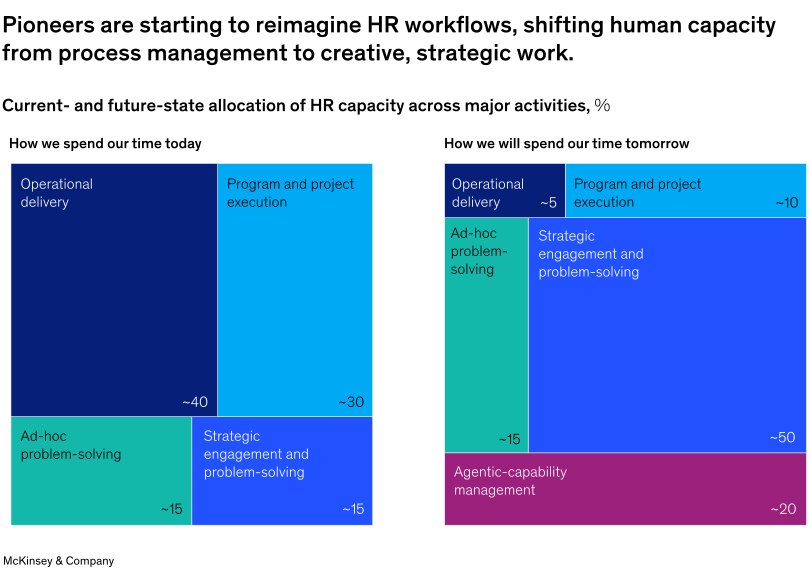
That last category deserves more attention than it usually gets. In the destination model, a meaningful share of HR jobs will consist of owning agents. The roughly 20 percent of human time devoted to agentic capability management is not a rounding category. It is HR professionals configuring agents in low-code environments, writing and reviewing the logic that those agents follow, testing their work before release, monitoring their performance and drift, and retiring them when the workflow changes. Work that sits closer to coding and product management than to case handling will become a normal HR career rather than a specialist sideline, and organizations should plan their hiring, training, and career paths accordingly.
The agentic model does not eliminate HR domains. Rather, it rewires them for purposeful collaboration between human judgment and agentic execution. Take talent acquisition: Agents clean records and analyze who the right candidate might be. A separate agent scores candidates and undertakes ranking and sourcing. Another contacts candidates and schedules interviews. A coordinating agent sits atop the overall process, interacting with the underlying agents. The recruiter’s job becomes designing, supervising, and improving that system, and owning the moments where judgment, relationship, and persuasion decide the outcome.
The structure of the function changes as well. The HR function can streamline its operating model by moving away from the traditional three-tiered Ulrich model, with HR split into business partnering, shared-services centers, and centers of excellence (COEs). In the new model, these tiers merge into one layer as shared-services centers become largely digitized and agentified, while COEs retain a few deep experts organized into tribes. These moves create a centrally steered, flexibly resourced network that becomes more strategic, collaborative, fluid, and data driven.
What does this look like on an actual organizational chart? One credible answer appears in Exhibit 3, and three ideas define it.
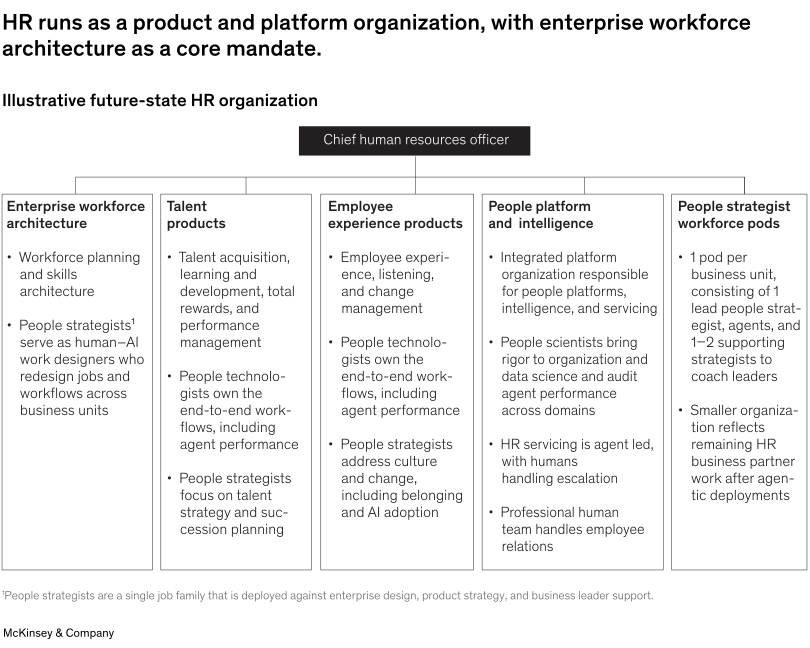
The first is the model itself. HR runs as a product and platform organization rather than a set of functional pillars. Work is organized around the products that the function ships and the platform they run on, so end-to-end redesign is native to the structure instead of negotiated across silos, and agent performance is owned the way any product feature is owned.
The second is that strategy work is concentrated in two groups. An enterprise workforce architecture group runs workforce simulations and the skills graph, and redesigns jobs and workflows across the business units, which is what makes the chief human resources officer (CHRO) a genuine peer to the chief information officer (CIO) on agent strategy rather than a customer of it. Alongside it, the traditional business partner population is revamped into small workforce pods, one per business unit, each a senior strategist with one or two analysts, focused on the hardest people calls in the business rather than on program delivery.
The third is that everything else consolidates into two product groups and one platform group. The talent products platform bundles hiring, growth, mobility, and performance under product managers who own their funnels end to end, including the performance of the agents running them. Employee experience products include rewards, recognition, and listening, with culture and change work on trust and belonging explicitly reserved for human employees. Beneath both sits a single people platform and intelligence organization that runs the agents, the data, and the service layer, with humans catching the exceptions.
This is the org chart version of the merged, single-layer model described above, and its demands are as clear as its logic. It requires product management muscle that most HR functions do not have today, a data foundation strong enough to run a skills graph, and a CHRO with a real enterprise workforce design mandate. Fewer organizations can start here. But for a function defining its North Star, this is what the destination looks like drawn as boxes and lines.
Human capabilities in the agentic HR model
The agentic model rewires HR domains for purposeful collaboration between human judgment and agentic execution. These changes must be accompanied by a change in the capability composition within HR. The shift away from centers of excellence, HR business partners, and shared services toward a centrally steered, flexibly resourced network creates multiple new roles. Four of the most common include:
- People strategist: Sets direction, translates business strategy into people priorities, and ensures that the right mix of human and agent capacity is deployed where it matters most. This small, senior group includes enterprise strategists continuing an executive partnership akin to an HR business partner, portfolio strategists managing the HR-wide backlog, and an innovation squad exploring next-generation people strategies.
- People technologist: Designs and maintains the agentic operating backbone, translating business needs into digital capabilities and ensuring AI and human workflows function seamlessly. Capability builders configure agentic workflows using low-code tools; agent integrators oversee governance, performance, and interoperability of agentic systems.
- People scientist: Provides the ethical, legal, and evidence-based guardrails for the agentic enterprise. This role oversees bias, risk, and data integrity in agentic workflows; runs experiments and validations to ensure outcomes are ethical and effective; and handles complex employee escalations requiring human judgment. This goes beyond system-level documentation. Under regulations such as the EU AI Act, each individual agentic decision must be explainable and contestable at the case level, not just the system as a whole.1
- Flow-to-work generalist: A flexible, high-skill talent pool deployed dynamically across HR to deliver strategic projects, fill capability gaps, or provide nuanced human engagement where automation cannot. This archetype also serves as an apprenticeship path toward future strategist or technologist roles.
Other new profiles are emerging as well, including agent orchestrators who design and supervise agent workflows, hybrid managers who lead blended human–agent teams, and AI coaches who help employees integrate AI into daily work. At the same time, other roles will disappear—for example, interpretive roles that historically were required to “connect the dots” across silos.
The agentic HR function also elevates the experience of every stakeholder it serves. Employees can access a single intelligent working platform that integrates work support, learning, and career development. The platform can anticipate potential career moves, curate growth opportunities, connect employees with mentors, and continuously update skills profiles based on inference. Work becomes simpler and more intuitive, growth and development become more personalized and continuous, and employees can spend less time navigating systems and more time driving innovation and impact.
Managers gain real-time visibility into team skills, readiness, and engagement, making it easier to understand what their teams need and how to help them succeed. Intelligent tools simplify the operational side of management, freeing time to guide, coach, and inspire. Static approaches to workforce planning based on human roles give way to dynamic, activity-based models that specify which tasks are performed by humans, AI agents, or hybrid teams.
People teams shift from program delivery to strategic design, enabling them to spend more time on analytics, experience design, and enablement, which in turn deepens their partnership with business leaders.
Four transition layers for agentic HR
While organizations are pursuing different paths toward an agentic HR function, the underlying transformation challenges are remarkably consistent. Regardless of where they begin, leaders must build the capabilities, operating model, technology foundation, and governance needed to support new ways of working. Achieving that transformation requires deliberate work across four interconnected areas. None can be addressed in isolation, and each must advance through a sequence of diagnosis, design, build, and pilot.
- Workflows: Every HR process can be examined through the lens of what humans and agents can contribute, and redesigned accordingly. This means mapping end-to-end HR processes across domains, identifying friction points and automation potential, redesigning key workflows as human-plus-agent systems, and documenting detailed process maps with inputs, outputs, and automation logic before any technology is configured. This layer is where the unit-of-analysis shift becomes operational: the deliverable is a redesigned workflow, not a list of automatable tasks.
- Organization and talent: The structural shift to a centrally steered, flexibly resourced network requires assessing the current HR structure, full-time-employee mix, and skill distribution. It also means anchoring on human capabilities and defining role accountabilities and transition paths. Increasingly, those transition paths lead toward agent ownership: The people who once ran a process become the people who build, tune, and govern the agents that run it.
- Technology and data enablement: The agentic HR model runs on a unified foundation of technology and data. Building it starts with auditing the current tech stack, integrations, and data quality. From there, teams define the target architecture and build-versus-buy strategy, build core infrastructure such as integrations, APIs, and data pipelines, and validate system readiness, data integrity, and security before going live.
- Transformation governance and change management: This is where most transformations succeed or fail. Success requires a transformation narrative and guiding principles, a transformation office with a clear governance cadence, AI-fluency programs, readiness assessments, and active change champions.
Five decisions CHROs need to make now
The CHRO can begin HR’s agentic journey by making five decisions, each of which shapes every subsequent move:
- What is our North Star? What unique value should the people function deliver to the business in 2030, and what mix of humans and agents will deliver it? What will we stop doing entirely? Does our picture take a real position on the three core tensions, or does it duck them? This is a CHRO-level decision, with input from the CEO, CFO, and CIO.
- Where do we enter, and in what sequence? Which entry point fits the organization’s starting point: individual use cases, end-to-end processes, or full domains? Which processes, populations, and proof points should come first, and why those?
- How do we rebuild HR’s own capabilities? Which capability moves are no-regrets and should start now, from AI fluency and workflow-redesign skills to data foundations and a first cohort of agent owners? Which shifts in roles and talent mix will play out over years?
- Who governs, and how do we balance frontline speed with enterprise coherence? Who leads the effort, and who holds decision rights when a local experiment conflicts with the enterprise architecture? When and how does the business get involved? Where does the orchestration platform sit: with IT, HR, or shared?
- What is the value case, and which choices are reversible? What is the value at stake across efficiency, effectiveness, and experience, and how will progress be tracked against it? Just as important: Which early choices are foundational, which compound over time, and which can be safely undone? Knowing the difference is what keeps speed from becoming recklessness.
Answering these with rigor and honesty is how the agentic journey begins. Organizations that do this up-front work move faster, make fewer costly course corrections, and build the organizational alignment that sustains momentum through the inevitable challenges of a multiyear transformation.
The journey to an agentic HR function is demanding. It requires courage, clarity, commitment, curiosity, and a willingness to make bold choices about what HR is for and how it should work. It is also one of the most significant opportunities available to HR leaders to build a function that is genuinely fit for the future, and to help the entire organization navigate into a new era of human–agent collaboration.