Transformations that deliver sustained, outsize improvements in performance are rarer than most leaders think. Change programs labeled “transformations” are often incremental efforts in planning, communication, or management that don’t fundamentally alter how the organization operates or how people work day-to-day.
While we have extensively studied what it takes to drive change, we have not previously examined the precise behavioral shifts that organizations emphasize during transformations—the discrete changes in how people work, lead, and collaborate. In new research, we set out to answer which behavioral shifts organizations prioritize and whether these changes create a “true” transformation.
We analyzed nearly 100 transformations and 1,000 specific behavioral shifts over the past five years to find the ten behavioral themes that organizations turn to during a transformation (see sidebar “Our methodology”). We found that the five most-used behaviors relate to cultural enablers that align the organization and engage its people—collaboration, commitment, continuous improvement, and the like. The five less-tapped behaviors reflect discipline and performance factors—including competitiveness and accountability—that are the hard drivers of results.
Our experience reveals that not all performance transformations are equal. Some are bolder and more transformative. Some deliver holistic improvements (financial, operational, customer, employee, and organizational). Some are more sustainable than others.
In a recent related analysis of 35 transformations that were the most successful, most sustained, and most transformative, the behaviors organizations turn to least often were far more prominent. These are the edgier behaviors that are harder to implement and more likely to upset people. Yet even though accountability is the single biggest differentiator of a real transformation, our new data shows that organizations selected accountability just 10 percent of the time.
The bottom line: Behaviors that sustain organizational health are important, but so are behaviors that improve performance, accountability, and competitiveness. Too many companies tend to neglect the latter behaviors crucial for true transformative change, even more so at a moment when reinvention-level change forces many organizations to craft new identities.
In this article, we discuss the five behavioral shifts that organizations use most, and the five “blind spots” that have unrealized potential to transform the behavioral fabric of the company. We also lay out actions leaders can take to help implement the behavioral shifts that are most important for their organization.
How behavioral shifts tie to organizational health and performance
“We have an aspiration so ambitious that the only way to achieve it is to transform ourselves.” This is the starting point for many a transformation: What are the behaviors that need to become natural, demonstrated habits?
Leaders don’t have to change all aspects of their organizational culture, but they do have to identify a small number of critical behavioral shifts that must take root for the transformation to be effective. These tend to be thematic, reflecting either cultural enablers or performance aspects. For example, in an organization that emphasizes continuous improvement, people at all levels focus on innovation and performance improvement. In a culture that focuses on decision-making, decisions are grounded in data and facts.
Behavioral changes must be the result of a robust diagnostic process owned by line leaders—triangulating strategic logic, the voice of the organization, and hard-nosed evidence of organizational effectiveness. This process is often anchored in the Organizational Health Index (OHI), which measures 43 management practices that drive nine outcomes of health, allowing leaders to target behaviors that define how the work is done and how the organization is led and managed each day.
We have learned that the most effective shifts are framed as “beyond–to” rather than “from–to.” For example, rather than saying “from silos to cross-functional collaboration,” consider “beyond collaboration to enterprise cocreation.” This avoids portraying the past as a problem or a failure and instead positions it as a foundation for evolution and continuous progress. Finally, the language for the chosen behaviors should be specific, actionable, and understandable across levels and functions.
The five ‘greatest hits’ of behavioral change
Our research indicates that the vast majority of companies undergoing transformation focus on some combination of five core behavioral themes: collaboration, commitment, continuous improvement, clarity of goals, and customer orientation. These themes center on aligning people with a clear direction, engaging and empowering employees, breaking down silos, and driving continuous innovation and improvement.
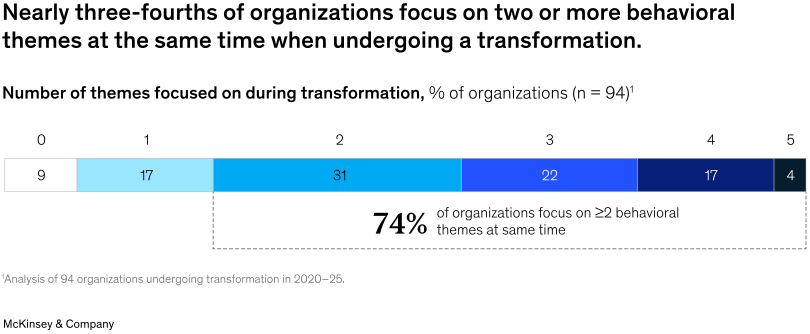
More than 90 percent of the transformations we studied pursued at least one of these shifts, and most organizations addressed two or three of them in tandem. Together, these five represent the “greatest hits” of behavioral change in transformations (Exhibit 1).
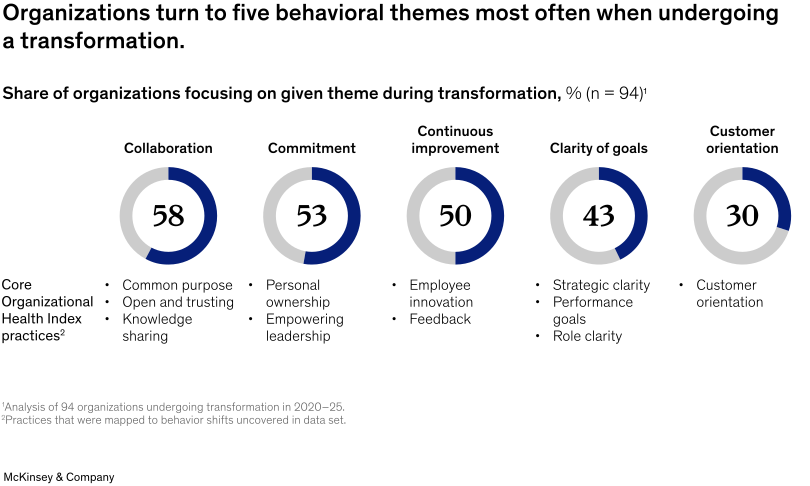
Collaboration. This was the most frequently cited theme, appearing in 58 percent of the organizations we analyzed. Companies striving for better collaboration break down silos and encourage people to think of “we rather than me.” When teams across the organization embrace a shared understanding of how their work fits into the transformation’s aspiration, they create an environment where combining ideas leads to extraordinary results.
Commitment. More than half of organizations (53 percent) emphasized employee commitment and engagement, with the goal of making people feel empowered, included, and listened to so that they can realize their full potential at work. Leaders nurture a culture of engagement and trust, coaching and recognizing employees to help them grow. This shift means employees feel motivated to contribute to transformation efforts.
Continuous improvement. Half of the organizations (50 percent) focused on fostering a culture of continuous improvement and innovation. With this shift, people at all levels are encouraged to participate actively in innovation and performance improvement activities, including bringing best practices from outside the organization. Leaders listen and act upon employees’ suggestions for improving processes, products, and services, making improvement a daily habit rather than a one-off project.
Clarity of goals. Achieving strategic clarity was a top priority for 43 percent of organizations. When transforming, strategic priorities are clear and aligned across the company, and communication is regular and transparent. Employees have well-defined roles and a strong understanding of what needs to happen to execute the strategy.
Customer orientation. About one in three transformations (30 percent) sought to sharpen the organization’s customer focus. As Peter Drucker stated, “The purpose of a business is to create and keep a customer.” Leaders create clear expectations that employees will deliver exceptional customer experience, using feedback to innovate and improve.
Each of these five behavioral themes reflects an energizing or enabling dimension of organizational health. They focus on aligning the organization (clarity and customer orientation), empowering and engaging its people (commitment and collaboration), and fostering a mindset of innovation (continuous improvement). It is no surprise that these areas consistently surface in transformation efforts.
In practice, companies often tackle multiple behavioral themes at once (for example, by improving behaviors related to collaboration and continuous improvement, teams work across silos to innovate faster). Leaders intuitively gravitate to these areas because they energize the organization by breaking down barriers, rallying people around a clear purpose, and unleashing fresh ideas.
Out of the nearly 100 transformations that informed our research, 74 percent focused on two or more behavioral themes simultaneously (Exhibit 2).
Five transformation ‘blind spots’
While it’s important that companies readily invest in the five widely adopted themes above, they often underinvest in other critical behaviors that are equally important for long-term performance improvements. We identified five behavioral themes that few organizations prioritized in their transformations. Each of these was found in only about 10 to 27 percent of the transformations we tracked.
These five “blind spots” are all about performance discipline—looking outward to winning in a competitive marketplace, making tough decisions, pushing for results, building strong teams, and upholding standards. The fact that they appear so infrequently in transformation plans is striking. We believe many transformations underemphasize the behaviors that are essential to most successful performance transformations because of the discomfort they create (Exhibit 3).
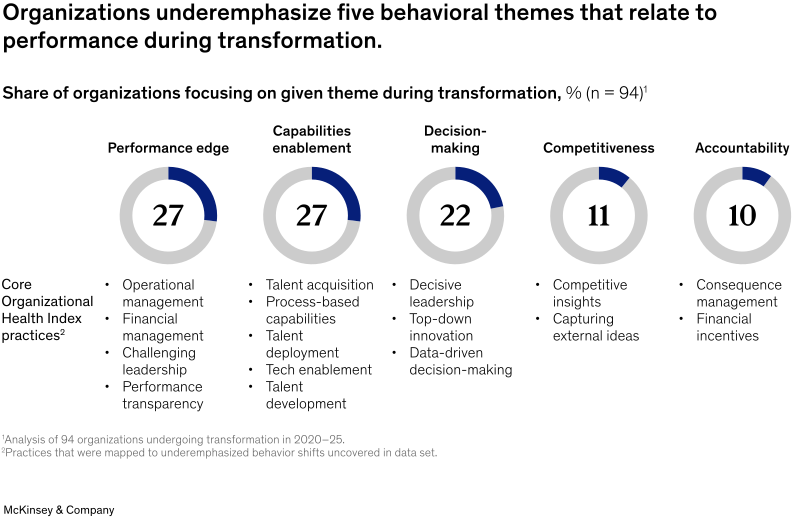
Performance edge. Organizations should be driven by clear financial and operating goals and metrics at all levels. By building a performance edge, leaders set an expectation that people will outperform, encouraging them to do more than they thought possible to meet stretch targets. In essence, they are injecting urgency and ambition into the transformation. This theme maps to OHI practices such as operational management, financial management, challenging leadership, and performance transparency, ensuring that goals in these practices will be bold, visible, and rigorously tracked. However, just 27 percent of transformations we researched had an explicit performance-edge theme, despite its importance.
Performance blind spots can cause three problems during a transformation. First, continuous improvement efforts often fail to deliver sustained impact unless paired with a strong performance edge. Without it, transformations risk becoming a collection of well-intended ideas that aren’t backed up with the discipline needed to execute—what many refer to as the “suggestion box problem.” In contrast, combining continuous improvement with performance edge creates the conditions for execution excellence, where ideas are not only generated but also consistently acted upon and scaled.
Second, without performance edge, the mechanism to ensure that ideas translate into measurable performance gains is absent. We discuss the importance of accountability, a foundational element for continuous improvement and a lasting transformation, below.
Third, a closer look at underlying OHI practices reveals a potential misalignment in what gets emphasized. While challenging leadership, a practice where leaders push teams beyond perceived limits, appears in 15 percent of transformations, the more foundational enabler, performance transparency, appears in only 4 percent. Yet it is transparency—clear visibility into goals, metrics, and progress—that most directly enables disciplined execution and continuous improvement. Furthermore, the practices that support performance transparency—financial management and operational management—are also rarely prioritized (4 percent and 5 percent, respectively), despite being critical for establishing the data-driven foundation necessary for sustained performance. In many cases, these practices may have more impact than leadership style alone.
Capabilities enablement. Only 27 percent of transformations we analyzed prioritized the capability-enabling practices of talent acquisition (recruiting, selecting, and hiring the right people), talent deployment, process-based capabilities, or tech enablement. Enabling capabilities is built on a foundation of on-the-job coaching and development. The blind spot here is that in many transformations, leaders simply develop and roll out training programs that end up having a limited impact on performance.
Decision-making. Roughly one in five transformations (22 percent) focused on sharpening decision-making behaviors. With this shift, leaders take decisive action and commit to decisions once they’re made, rather than second-guessing or revisiting them. Decisions are grounded in data and facts, and leaders drive innovation by pushing initiatives forward. Drawing on practices such as decisive leadership, top-down innovation, and data-driven decision-making, this behavior fosters timely, fact-based, and bold decisions.
Many organizations can trace the roots of their performance challenges to a series of decisions that were of poor quality or that lacked speed and flexibility. Flagging these behavioral shortcomings can be perceived as an indictment of either the current operating model or of leadership, and in many cases there is no appetite to confront these problems head-on. A significant overhaul of the operating model or questioning leadership can make many leaders feel that their base of power, influence, and decision rights are being challenged.
However, without addressing decision-making, collaboration isn’t effective. In fact, breakdowns in collaboration are often traced back to, or are exacerbated by, dysfunctional decision-making because there is no clear guidance on how to proceed.
Competitiveness. This behavioral theme is about looking outside the organization’s boundaries to understand market trends, the competitive landscape, and the company’s value proposition compared with competitors. Leaders in these shifts use external best practices and industry ideas to drive improvement over time. Underlying management practices include competitive insights and capturing external ideas, emphasizing an outward-looking mindset. Yet only 11 percent of organizations explicitly addressed improving their competitive insight and external orientation—a dramatically low number given the stakes.
Accountability. Just 10 percent of transformations we analyzed prioritized accountability and consequences, a percentage that our transformation experts viewed as surprisingly low. Accountability is a key theme that puts teeth into behaviors related to commitment, continuous improvement, and clarity of goals. It links to the OHI practices of consequence management and financial incentives. Without accountability that leads to consequences, it is up to individuals to decide how committed they are, whether they will fulfill their role requirements and enable the broader strategy, and whether they want to drive and deliver on performance improvements (see sidebar “Accountability applies to everyone, every day, on everything”).
These five blind spots suggest that many leaders may be more comfortable focusing on cultural and engagement-related shifts and are underweighting areas that are more oriented toward winning in a competitive marketplace. Indeed, the data implies a potential imbalance: Companies readily invest in energizing the organization, for instance, by fostering collaboration or clarifying purpose, but often pay less attention to ensuring a competitive, high-performance engine through rigorous decision-making, aggressive goal setting, capability building, and accountability for outcomes.
Fewer than one-third of transformations set a performance edge focus, and only one in ten made accountability a top theme. If holding people accountable is not a priority, organizations risk perpetuating a culture with few consequences for underperformance, which can undermine the very goals of the transformation. Similarly, ignoring competitiveness or decision rigor can leave a company inwardly focused and sluggish, even as it rallies employees around vision and teamwork.
The related McKinsey analysis of organizations that focused on comprehensive performance transformations we note above underscores this point. Thirty-five companies that enabled the five blind-spot behavioral themes increased their EBITDA by 2.7 times that of their original momentum case in the three years after their transformation program began.
Implications for leaders: Balancing engagement with performance edge
The clear takeaway for leaders is that transformation demands balance. When done well, performance and engagement reinforce each other. Leaders should ensure that alongside cultural enablers, they incorporate performance disciplines such as decisive decision-making, competitive benchmarking, and rigorous accountability to dramatically improve performance.
Once they choose the most important behavioral shifts for their organization, leaders consider five actions to move into implementation.
Focus on the teams that matter most. Not all teams have equal impact. High-performing organizations concentrate their efforts on critical teams—those at the crossroads of value, influence, and energy. When clearly aligned, empowered, and supported, “teams of teams” can become accelerators for system-wide change. One European company restructured its operating model around 15 such teams, applying the mantra “star teams, not teams of stars.”
Use decision-making as a cultural accelerator. Culture is most visible in how decisions are made—who decides, how fast, on what basis, and with what ownership. Leading organizations treat decision-making as a muscle. They clarify roles, build decision routines into leadership cadences, and use data to learn and adapt. For example, a financial services firm used OHI diagnostics and targeted hackathons to resolve role ambiguity and limited accountability, restoring clarity and speed in key decisions.
Rewire performance routines for ownership and learning. Performance culture is built in the drumbeat of day-to-day execution. Too often, business reviews and leadership meetings default to reporting rather than reflection or action. Forward-leaning companies are redesigning these routines, including monthly reviews, transformation offices, quarterly business reviews, and town halls, to drive real-time learning, peer challenge, and joint prioritization. One energy player reshaped its operations reviews into coaching-style sessions; another embedded objectives and key results into a rhythm that reinforces ownership and behavior alignment.
View culture through the eyes of employees. Culture only matters if it shows up in the lived experience of work. Organizations are increasingly using tools such as employee personas, experience mapping, and “walk in their shoes” methods to assess whether key themes—like accountability, clarity, or energy—translate meaningfully into daily activity. For example, a global bank used employee personas and journey mapping to reveal that while accountability was a core value, unclear decision rights often left teams hesitant to act. This prompted changes to clarify ownership and empower faster decisions.
Make cultural practices observable and peer reviewed. Like safety, culture becomes real when it is embedded in routines that are visible, testable, and shared. Teams build habits—such as feedback loops, decision hygiene, and learning rituals—and periodically assess and refine them with employees’ input. This makes culture tangible and improvable.
True transformation—not just a performance boost—requires leaders to transform the behavioral fabric of the company. Organizations must shift from overindexing on “soft” behaviors that build engagement to the harder aspects of change, such as accountability and competitiveness, that open uncomfortable yet necessary conversations. When choosing from this menu of ten behavioral themes, organizations can prioritize how to lead, how to manage, and how the work gets done day-to-day in ways that support their highest aspiration.
Related Articles

Change is changing: How to meet the challenge of radical reinvention