Healthcare providers continue to face considerable financial and operational headwinds, including reimbursement pressures and higher labor and supply costs. In response, health systems and care delivery providers are looking to improve cost and performance while maintaining access, improve clinical staff and patient experience, and deliver high-quality, timely, and effective care.
In the pursuit of financial and operational improvements, health systems have focused on internal shared services functions. Within shared services, revenue cycle is a leading candidate for disruption and optimization. Revenue cycle management (RCM)—encompassing nearly all patient interactions outside of the clinical episode as well as end-to-end administrative processes—owns the responsibility for collecting patient services revenue.
Healthcare executives have spent decades pursuing a simple but elusive goal: a revenue cycle that runs itself. Billions have been invested in automation, yet most systems still depend on globally placed billing staff working through a patchwork maze of loosely connected point solutions and IT systems. The result has been some value creation, but it is limited to focused areas within the revenue cycle.
Now, health systems are turning to AI for help. The latest AI iteration, agentic AI, is unlocking the first credible path to a truly tech-enabled and well run revenue cycle. Agentic AI represents a significant evolution in AI, characterized by its ability to autonomously make decisions and execute complex end-to-end processes, unlike gen AI, which primarily provides advisory support. In effect, it can function more like a coworker than a tool.
The implications for revenue cycle are profound. According to McKinsey analysis, using AI to enable the revenue cycle could lead to a 30 to 60 percent reduction in cost to collect, faster cash realization, and a workforce refocused on patient value rather than administrative tasks. For patients, improved RCM could mean faster access to care and streamlined, less-complex billing. In the next two to three years, leading health services technology companies and innovative health systems will move from pilots to production-scale deployments of agentic AI across the revenue cycle.
In this article, we discuss how health systems can start deploying agentic AI by focusing on the back end of the revenue cycle and how they can begin capturing value from it. Health systems that act decisively can set the standard for what a well-run revenue cycle can mean for patient experience and the organization’s financial health.
The back-end revenue cycle: Ignition for agentic AI
The investment that health systems make in revenue cycle is staggering. The process typically costs 3 to 4 percent of an at-scale health system’s revenue.1 Collectively, health systems spend more than $140 billion annually, with manual processes, fragmented vendor landscapes, and outdated technologies contributing to high costs, delays, and errors.2 Beyond costs, nearly 20 percent of claims, on average, are denied3; as many as 60 percent are never appealed, resulting in millions of dollars in lost revenue for the average health system.4
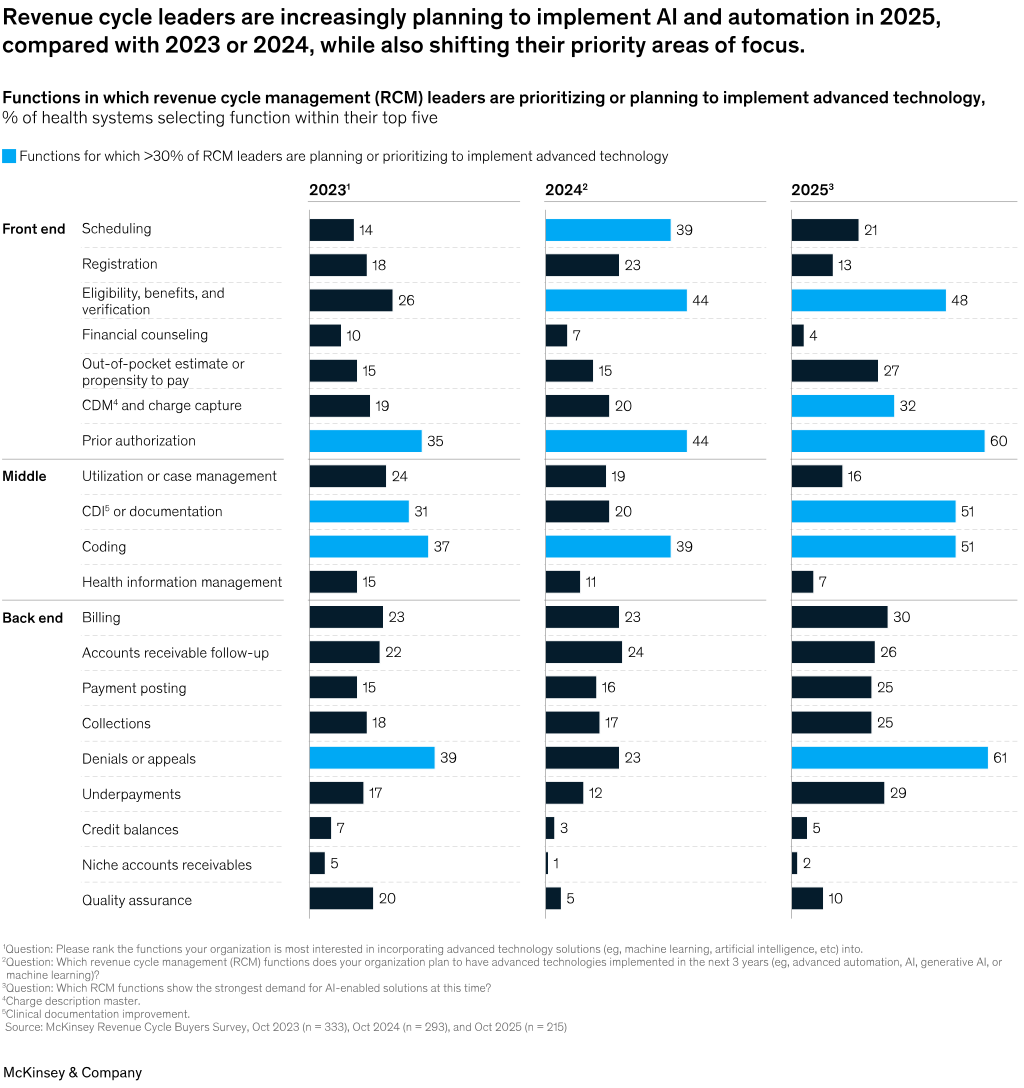
Addressing the revenue cycle through AI is top of mind for healthcare executives. In 2025, more than 30 percent of providers prioritized implementation of AI and automation for seven specific use cases across the revenue cycle (compared with four to five use cases in 2023 and 2024). The vision of an integrated and automated capability spanning the full spectrum of RCM is yet to be articulated (exhibit).
To date, most of the deployments of agentic AI in healthcare have been with third-party healthcare technology vendors. Few health systems have deployed agents on their own. Those that have done so use them in discrete point solutions rather than integrated across tasks.
Indeed, the idea of automating the end-to-end revenue cycle can be daunting. Managers must deal with many interconnected processes—patient scheduling, clinical documentation, claims processing, and collections—and interdisciplinary dependencies such as with vendor management, procurement, legal, managed care, and clinical staff. It’s evident why organizations might hesitate to dive in. But there’s a clear and practical way to ease into RCM agent-led automation: focusing on the back end of the revenue cycle.
High potential for making labor-intensive tasks autonomous
The back end is full of labor-intensive, rules-governed tasks in which staffing constraints are the primary gatekeepers to 100 percent completion of work. This circumstance is ideal for agentic AI. Functions such as accounts receivable follow-up, underpayment management, denials management, and cash posting are time-consuming, but they follow clear patterns that AI can learn and replicate (at least in part) by allowing human operators to manage exceptions. Automating these tasks can reduce labor hours while increasing the volume of claims worked with a high degree of fidelity. By taking on these high-volume workflows of varying complexities, agentic AI can free staff up to focus on more-strategic activities, spurring efficiency and productivity across the organization.
Incremental implementation for initial buy-in
Starting with the back-end revenue cycle, executives don’t need to overhaul the entire system at once. Instead, they can tackle one use case at a time and build on already completed projects—for example, automating denials management today and underpayments tomorrow. This sequential approach allows organizations to spread out investments and demonstrate proofs of concept once milestones (including value capture) are achieved. Our experience has shown that focusing efforts within a single area (for example, RCM)—whether for use cases in parallel or sequentially—has shown to be most effective in creating value while also building conviction on the utility of automation.
A safer space for testing and refinement
The back-end revenue cycle is largely administrative, making it a lower-risk environment for deploying agentic AI. That’s in contrast with front-end functions such as scheduling, which involve direct patient engagement, or midcycle tasks such as clinical documentation improvement, which touch on clinical decision-making.
Back-end workflows follow clearer rules, allowing for more clarity on ensuring compliance, and they have fewer patient-facing touchpoints, which means there is less risk of disrupting the patient experience. It is a relatively safer space to test and refine agentic AI, with guardrails against unintended consequences.
A foundation for broader transformation
Starting with the back end lays the groundwork for a broader transformation. Proving the effectiveness of agentic AI in this controlled, lower-risk environment builds trust with health system leaders, clinicians, payers, patients, and other stakeholders. It also sets the stage for a more holistic redesign of the revenue cycle, connecting workflows and ensuring process accuracy meets or exceeds human capabilities. Once the back end is optimized, organizations will be better positioned to tackle more-complex patient- or clinical-facing areas of the revenue cycle and have more transparency about revenue implications.
How health systems and providers can realize value from agentic AI
To begin capturing value from agentic AI, providers should balance rapid time-to-value expectations with a longer-term vision of impact. Starting at a modest scale is important—but not so small that progress stalls or fails to inspire. At the same time, providers should think holistically about how their initial efforts could scale across their ecosystem and which approach—build, buy, partner, or some combination—will best support their goals and timelines. Here are four considerations to guide the journey.
Start with a proof of concept, but don’t get stuck in pilot purgatory
Launching with a proof of concept is necessary to demonstrate potential and build organizational buy-in. But it is also important to avoid getting discouraged by lack of immediate financial impact. Instead, pilots should be structured with clear and pragmatic success metrics that can be used to assess longer-term value. Once the potential for value is realized, transition quickly to scaling the solution across the organization. This approach ensures early momentum translates into enterprise-wide transformation rather than stalling at the pilot stage.
Be strategic about build, buy, or partner decisions
Choosing the right approach to agentic AI isn’t just about selecting the best vendor or, conversely, building it all. It’s about aligning with organizational priorities, whether that means retaining intellectual property by building in-house or achieving speed and scale through partnerships or enterprise platforms. Let the business objective inform the approach.
For most providers, a truly end-to-end solution will require a mix of building and buying to achieve best-in-class performance and accuracy. With this in mind, providers need to be strategic, with clear plans for their technology infrastructure as well as robust change management to truly integrate autonomous end-to-end solutions that can capture meaningful value.
Prioritize what will drive the organization forward
Focus first on what matters most to the organization and aligns with strategic priorities. For most providers, identifying high-value areas where agentic AI can make a measurable difference means targeting the highest-volume, most error-prone processes—those with clear, quantifiable outcomes such as improved denial overturn rates, accelerated accounts receivables, or meaningful reduction in time to complete tasks (adjusted for complexity). By being intentional and strategic with initial use cases, executives can maximize ROI and build momentum for a larger transformation.
Invest in change management and people
The shift to agentic AI is as much about people as it is about technology. Staff may wonder how their roles will change, making it essential to communicate that agentic AI augments the workforce. As AI agents take on day-to-day tasks, human responsibilities will shift toward training the agents, interpreting complex outputs, handling exceptions, and enabling the delivery of patient-centered care.
Some providers are establishing AI centers of excellence to accelerate the development of both AI infrastructure and use cases, serving as hubs for innovation and governance. These centers often bring together specialized talent—including product owners, development leads, data scientists, AI engineers, customer experience leads, and operations leads—to promote scalable and responsible AI adoption, all in concert with business objectives in mind.
But true transformation occurs only when humans and agentic AI can work side by side, enabling optimal performance for both. Measuring this impact while reinforcing opportunities for improvement will be critical to durable success.
Expected outcomes and measuring success
If successfully implemented, a touchless RCM engine could deliver transformational value. For example, if a largely agentic AI back-end RCM solution could reduce a cost to collect of 3.5 to 4.0 percent by one to two percentage points, this could be $60 million to $120 million in savings for a health system with $6 billion in patient revenue.
While agentic AI can potentially enable such savings, providers could also look at other ways to define success as they start to build out an agentic back end. For example, operational metrics such as initial denial rates, denial write-off rates, and accounts receivable days can offer indications of a provider’s financial health. These measures can give early signals that solutions are providing impact, even if agentic AI has not been fully rolled out across the back end.
Further, as staff upskill to be able to train and work alongside AI models, take on more complex and atypical work, and use AI tools as aids, they can refocus their time on higher-value efforts. Providers should aim to measure across these different dimensions—cost savings, reallocated time, operational improvement, and, ultimately, impact to revenue—early on to guide evaluation of priorities.
At first, the touchless RCM will be unlocked in parts across front-, middle, and back-end operations. Eventually it will move toward largely autonomous end-to-end capabilities. The ultimate vision is an interconnected network of agents, from patient scheduling to collections, working together to optimize the revenue cycle. A human will always remain in the loop to better train models, work exception cases, and ensure compliance.
The healthcare industry has long awaited transformational change in RCM performance. With agentic AI, that change is no longer a distant promise. As health systems move the revenue cycle from a fragmented and reactive process to an intelligent and adaptive system, this moment may represent the tipping point: a rare opportunity to improve patient experience, modernize operations, reduce administrative overhead, and create sustainable value at a time when it’s needed more than ever.