Have you ever taken your airplane seat, looked around, and wondered exactly how much money the airline is making from your flight?
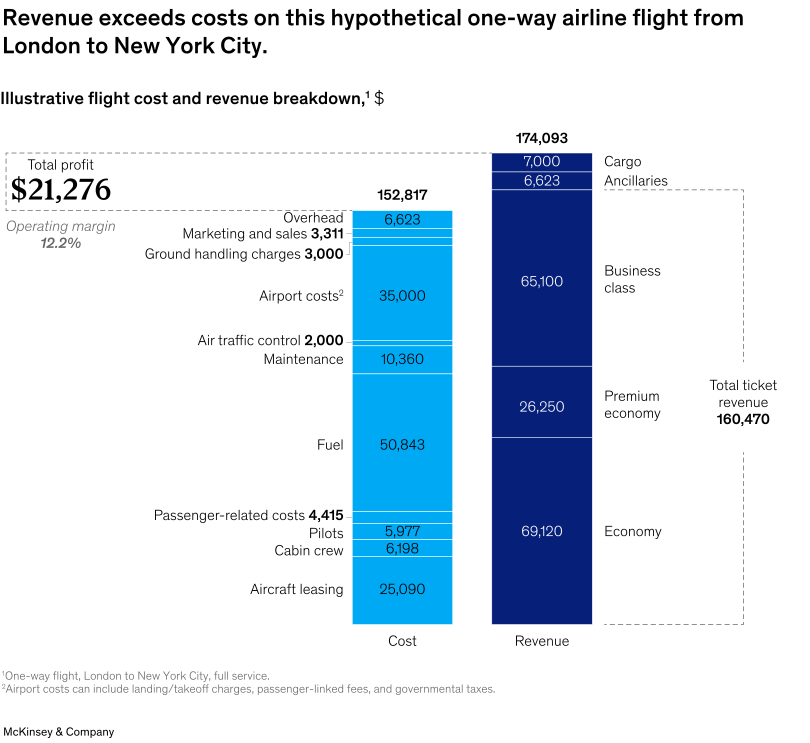
In the below video, McKinsey’s Steve Saxon and Jaap Bouwer analyze a hypothetical one-way flight from London to New York City, laying out the sources of costs and revenues for the airline. Underneath the video, a detailed chart breaks out those precise cost and revenue drivers.
Next time you fly, you’ll have a better understanding of airline economics—and maybe have something interesting to chat about with your seatmate.
Steve Saxon: Have you ever taken your seat on an airplane, looked around you, and wondered, “Is the airline actually making any money?”
We’ll take one hypothetical flight and look at the revenues and the costs. The next time you’re taxiing toward takeoff, you may have a whole new view on the business of flying.
Jaap Bouwer: We’ll start with the revenue side of the ledger.
Steve Saxon: We’ll be flying from London to New York on a Boeing 787. That’s a typical aircraft for this flight.
Jaap Bouwer: In economy class, we may have 192 seats. If 90 percent of them are filled, that would yield 173 passengers.
Steve Saxon: Based on some checks of available prices, a round-trip fare comes out to be about $800 for such a trip. This is one-way, so we’ll take half of that, or $400 per passenger.
Jaap Bouwer: 173 passengers times $400 equals about $69,000 in revenue.
Steve Saxon: But that’s not the only cabin on board this aircraft. You might have sprung for premium economy class or business class, for example.
Jaap Bouwer: Thirty-five premium economy seats 75 percent filled, that’s 26 passengers in premium economy.
Premium economy round-trip fare might be $2,000 on average for this type of flight, so that means $1,000 one-way. That comes out to $26,000 in revenue from premium economy.
In business class, there may be 31 seats. If we assume they’re 70 percent full, that means 22 passengers. Average business fares will be higher. Maybe it’s around $6,000 round trip for this kind of flight. So that means $3,000 one way.
Steve Saxon: So let’s add it all up. The airline gets about $160,000 in ticket revenue on this flight.
But what other ways does this flight make money?
Let’s talk about ancillaries, things that the airline sells beyond the ticket. For example, maybe you checked a bag, or maybe you paid for your seat selection, or maybe you bought something [during the flight], or maybe the credit card you used bought some points from the airline.
Jaap Bouwer: Ancillaries will average roughly $30 per passenger. There are 221 passengers on board, so that’s about $6,600 in revenue.
Steve Saxon: There’s another revenue source you might not think of as an airline passenger. Let’s talk about cargo.
Jaap Bouwer: Roughly half the world’s air freight is carried in the bellies of passenger aircraft. An aircraft like this will have roughly ten metric tons of capacity available for air cargo. If we assume that 50 percent is filled, that means five metric tons of cargo.
Steve Saxon: Cargo prices vary. Let’s assume $1.40 per kilo for cargo revenue. That would give us a total of $7,000 in cargo revenue for the flight.
Now let’s total up all the revenue. The airline’s bringing in about $174,000 for this flight.
Sounds like a decent haul, but the story doesn’t end there. Let’s look at the other side of the ledger.
Jaap Bouwer: Let’s think about the cost the airline incurs when it flies you from place to place.
Steve Saxon: An aircraft such as the 787 can be leased or owned. Let’s assume it’s leased. A lease rate for an aircraft like this is around $1.3 million per month. We need to figure out how much that is per hour, and therefore how much for this flight.
Jaap Bouwer: This type of aircraft might fly 14 hours per day, so that means around 5,000 hours per year. If you do the math, that’s $3,150 per hour.
Steve Saxon: This plane will be in operation for about eight hours, which gives us a total of about $25,000 for leasing cost.
Jaap Bouwer: The airline needs to pay the flight attendants.
Steve Saxon: A flight like ours will have around eight flight attendants on board. Typical salary and benefits for a flight attendant could be $70,000 per year.
Jaap Bouwer: Cabin crew may fly about 60 hours per month, meaning 720 hours per year, and therefore, $97 per hour.
This flight takes eight hours. There are eight crew onboard, so there’s $6,200 in cabin crew cost.
Steve Saxon: But flight attendants aren’t the only crew; someone needs to fly the plane.
Jaap Bouwer: A flight like this will have two pilots in the cockpit. Let’s assume $270,000 in salary, training, and benefits cost.
Steve Saxon: For an eight-hour flight with two pilots onboard, total pilot cost is around $6,000.
There are some passenger-related costs, such as amenities, catering, and in-flight entertainment.
Jaap Bouwer: These can vary by length of haul and cabin of service, but let’s assume the cost [for this flight] is $4,400.
Steve Saxon: These are [amenities] you can see from your seat, and we’re up to almost $42,000 in costs. What about things that are harder to see?
You know what it’s like to fill up your car at the pump or maybe plug in your EV [electric vehicle], but what does an airline spend on jet fuel?
Jaap Bouwer: An aircraft like this will burn about 2,900 gallons of fuel per hour. There are eight hours in this flight, so that means about 23,000 gallons of jet fuel burned.
Jet fuel prices vary. If we assume a current jet fuel price of around $2.20 per gallon, that means almost $51,000 in fuel costs—the largest single cost item for the airline.
Steve Saxon: The airline needs to make sure the aircraft is in tip-top shape.
Jaap Bouwer: An aircraft like this may have maintenance costs on average of $1,300 per hour. For an eight-hour flight, that means about $10,000 in maintenance costs.
Steve Saxon: Air traffic control charges depend on the distance flown, the takeoff weight of the aircraft, and which countries are overflown. For this flight, let’s assume an air traffic control charge of $2,000.
So far we’ve been talking about the costs needed to keep the plane in the air and the passengers happy, but what about the costs on the ground?
Jaap Bouwer: To access airports at either end of the journey, airport charges need to be paid.
Steve Saxon: Yes, airlines need to pay airport costs on each side of the flight. London and New York are particularly expensive, and we might expect $35,000 for this flight.
Jaap Bouwer: Ground handling charges are for checking in passengers and their bags, handling [the boarding and disembarking ramp] for the aircraft, unloading cargo, and so forth. We can expect about $3,000 for this flight.
Steve Saxon: Marketing and sales costs can include advertising, promotion, and commissions paid to travel agents.
Jaap Bouwer: Let’s assume marketing and sales costs are about $15 per passenger. With 221 passengers onboard that’s about $3,300 in cost.
Then there are overhead costs for things like the airline’s corporate office building, or the staff that works there.
Steve Saxon: We can assume about $30 per passenger for that, which would give us a total of $6,600 overhead.
Jaap Bouwer: Add it all up, and the total costs for operating this single flight are about $153,000.
Let’s put it together. We can subtract the operating cost from the revenue to see how much the airline made from this flight.
Steve Saxon: We have $174,000 in revenue and $153,000 in cost.
Jaap Bouwer: We subtract cost from revenue. So that gives us an operating profit of $21,000, or roughly 12%.
Steve Saxon: That sounds like a good margin. But it’s a bit more complicated than that. The average airline industry margin is only around 3 percent to 6 percent.
Jaap Bouwer: Why was our margin higher?
Steve Saxon: First, we chose a healthy route. Lots of people want to fly between London and New York.
And they’re willing to pay for it. The London to New York route is one of the most premium in terms of business passengers.
If we picked a less healthy route, things might look different.
Jaap Bouwer: Furthermore, some passengers may be connecting passengers. Connecting-passenger yields are typically 20 to 30 percent lower than point-to-point passengers.
Steve Saxon: On the cost side, maybe the airline’s using sustainable aviation fuel, which is more expensive. Or maybe the flight was delayed, which would trigger additional charges.
Jaap Bouwer: This is a rough example, and we left a few things out. But as you look at the revenue and cost drivers, you start to get a better feel of how the airline industry works.
Steve Saxon: Maybe you can see why airlines are at the edge of profitability. They’re on thin margins, and it’s easy for things to change and go wrong quickly.
Jaap Bouwer: Airlines have developed and continue to develop various strategies to improve their profit.
Steve Saxon: On the revenue side, they can enhance pricing and revenue management, or they can build bundles of products.
Jaap Bouwer: On the cost side, the airline might work to enhance its aircraft utilization, optimize its maintenance checks, or lower its distribution charges.
Steve Saxon: You can think about airline revenue the next time you pay for a ticket or pay to check a bag.
Jaap Bouwer: And you can think about the airline’s costs the next time you step off a flight that was perfectly on time, with the cabin crew taking great care of you.
Steve Saxon: Now you’ve got something to talk to the passenger next to you about while you’re waiting for takeoff.